
Mastering the Quantitative PhD Thesis: A Comprehensive Guide
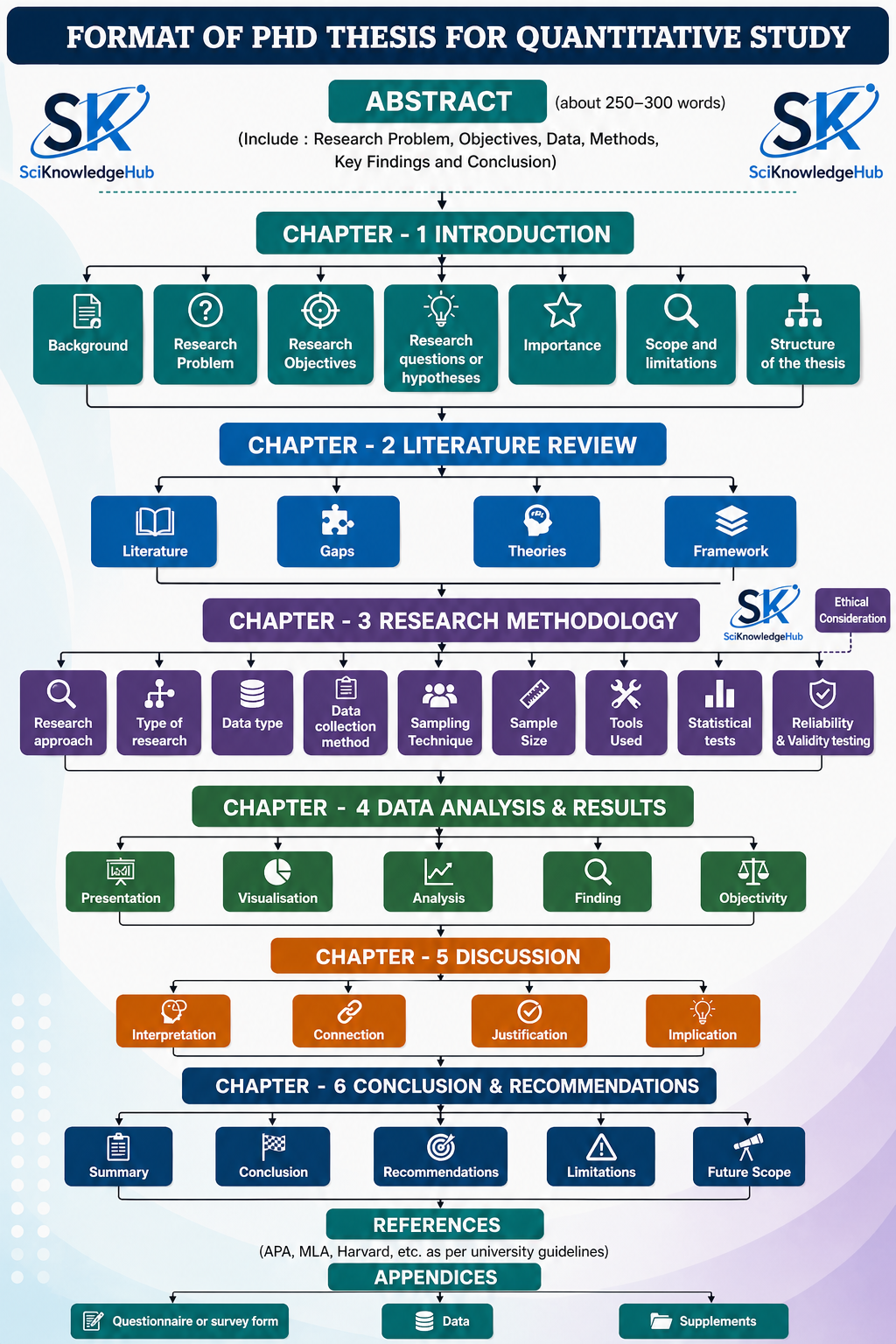
A well-structured PhD thesis is not merely a formal requirement; it is a logical narrative that transforms a research idea into scientifically defensible knowledge. The figure presents a comprehensive and sequential framework for organizing a quantitative PhD thesis, ensuring clarity, rigor, and coherence across all stages of research.
Test your Knowledge
Abstract: The Research in Miniature
The abstract (≈250–300 words) provides a concise yet complete snapshot of the study. It should clearly articulate the research problem, objectives, data sources, methodology, key findings, and conclusions. A well-crafted abstract enables readers to quickly assess the relevance and contribution of the research.
Key Features of an Effective Thesis Abstract
Chapter 1: Introduction
This chapter lays the conceptual foundation of the study. It begins with the background, establishing context and relevance, followed by a clearly defined research problem. The objectives and research questions or hypotheses guide the study’s direction, while the importance highlights its scientific and practical value. Finally, scope, limitations, and thesis structure ensure transparency and guide the reader through the document.
Chapter 2: Literature Review
The literature review critically synthesizes existing knowledge. It identifies key studies, highlights research gaps, and situates the work within relevant theoretical frameworks. This chapter bridges past research with the current study, justifying the need for new investigation.
Chapter 3: Research Methodology
This is the technical backbone of the thesis. It details the research approach (quantitative), study design, and data type, along with data collection methods and sampling techniques. It also specifies sample size, tools used, and statistical analyses, ensuring reproducibility. Importantly, reliability, validity, and ethical considerations strengthen the credibility of the research.
Chapter 4: Data Analysis and Results
Here, raw data are transformed into meaningful insights. This chapter emphasizes systematic presentation, visualization, and statistical analysis of results. Objectivity is crucial—findings must be reported without bias, supported by appropriate tables, graphs, and statistical outputs.
Chapter 5: Discussion
The discussion interprets the findings in light of existing literature. It explains patterns, relationships, and unexpected results, establishes connections with prior studies, and provides justifications and implications. This is where the study’s intellectual contribution becomes most evident.
Chapter 6: Conclusion and Recommendations
The final chapter synthesizes the entire study. It presents a concise summary, draws evidence-based conclusions, and offers practical or policy recommendations. Acknowledging limitations enhances transparency, while identifying future research directions extends the study’s impact.
References and Appendices
The thesis concludes with well-structured references (APA, MLA, Harvard, etc.) to ensure academic integrity.
Appendices provide supplementary materials such as questionnaires, raw data, or additional analyses that support the research but are not included in the main text.
Why This Structure Matters
This structured approach ensures:
- Logical flow from problem identification to solution
- Scientific rigor and reproducibility
- Clarity for readers, examiners, and stakeholders
- Alignment with international academic standards
A quantitative PhD thesis is more than a collection of chapters, it is a coherent scientific argument. Following a structured framework like this not only enhances the quality of research but also strengthens its contribution to knowledge, policy, and practice.